Boat gear / Winter storage
How to store boat batteries for winter.
A simple off-season plan for starting and trolling batteries—without treating every battery the same.
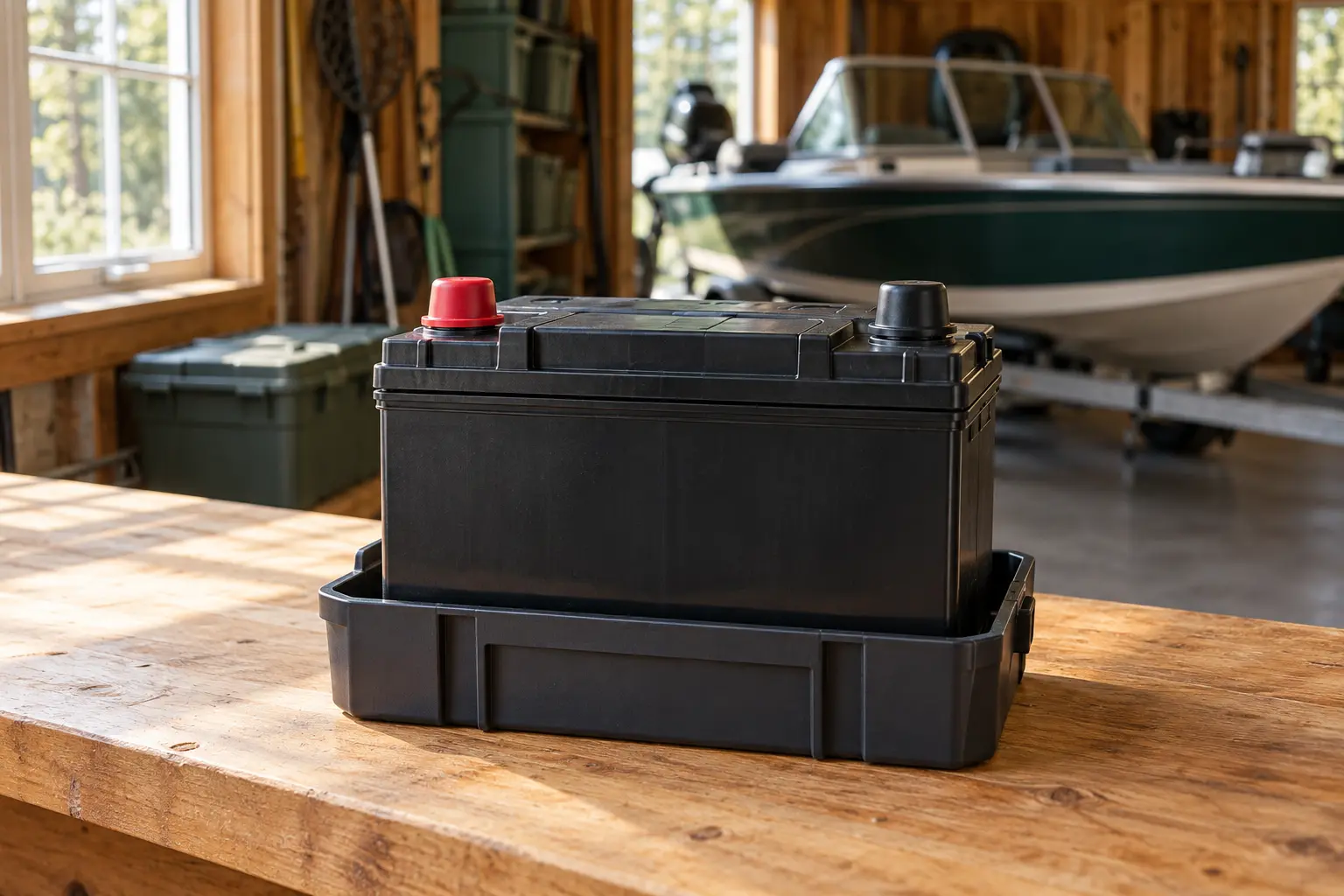
Putting the cover on your boat is a good time to make a separate battery plan. Write down where each battery will spend the winter, how you will check it, and which charger mode it needs. This is a researched care guide, not a hands-on battery test or a wiring tutorial.
1. Make a battery inventory
Photograph the labels and cable layout. Record each battery’s model, voltage, chemistry, and job: engine starting, trolling, or accessories. Keep the photos with the manuals so spring reconnection does not depend on memory.
| Battery type | Winter storage priority |
|---|---|
| Flooded lead-acid | Charge before storage; follow the maker’s electrolyte and charge-check instructions. |
| AGM | Use the specified AGM charging profile. Do not open it or add water. |
| Lithium iron phosphate (LiFePO4) | Use the exact model’s storage charge, temperature limits, and shutdown procedure. |
“Marine” and “deep cycle” alone do not identify the chemistry. If the label is unreadable, resolve that before choosing a charging mode.
2. Leave them in the boat or bring them inside?
Make the decision around the manufacturer’s permitted storage temperatures, protection from weather, and your ability to inspect the batteries. A hard-to-reach compartment under a winter cover is worth considering when you choose a storage location.
Trojan recommends a cool, dry, protected location for its lead-acid batteries and avoiding freezing conditions. Store them fully charged and check their charge during the layup. A discharged lead-acid battery is more vulnerable to freezing.
For lithium, check the actual model limits. Battle Born’s winterization guidance recommends a full charge and isolation from system loads for its batteries, with removal to a warmer location when severe cold exceeds its guidance. That is not a universal storage-charge prescription for every lithium brand.
If the boat stays afloat: do not blindly disconnect power needed by automatic bilge pumps or other essential systems. Have a marine technician help plan storage power. This guide’s simple disconnect-and-store approach is intended for a boat laid up out of the water.
3. Inspect before charging
Check for cracks, leaks, damaged cables, and corrosion. Have damaged batteries evaluated rather than connecting a charger and hoping they recover. Never charge a frozen battery. Wear suitable eye and hand protection, provide ventilation, and keep sparks and flames away.
On a serviceable flooded battery, follow the maker’s watering sequence and use distilled water. Do not add acid or overfill it. AGM batteries are sealed: do not treat them like refillable flooded batteries. Use their specified charge settings and avoid unapproved equalization or repair modes.
4. Prevent a slow drain all winter
A fish finder that looks off is not proof the entire electrical system is isolated. Identify accessory circuits and any equipment that bypasses the main switch. Follow the boat and battery manuals for shutdown; get help with unfamiliar series or parallel wiring.
For lithium batteries, check whether there is a storage mode or a heater that needs to be disabled. Cold-weather discharge capability does not mean cold-weather charging is permitted. Let the battery’s charging-temperature limits govern, even if your charger operates in colder air. Never bypass low-temperature protection to force a charge.
5. Choose a charging plan, not just a charger
Use a charger matched to voltage, chemistry, and permitted charging current. Leaving a charger connected all winter is appropriate only when both manuals allow that maintenance arrangement. A battery that can be charged by a device is not automatically approved for months of continuous connection.
The NOCO GENPRO10X2 is one option for compatible two-bank 12V systems. NOCO lists automatic long-term maintenance and selectable battery modes. It is more equipment than a single removed battery necessarily needs, and its cold-weather capability does not override your battery’s limits. We have not field-tested it.
Before shopping, use our onboard charger guide to check bank count, amps, and fit.
As an Amazon Associate I earn from qualifying purchases.
View GENPRO10X2 on AmazonConfirm the selected model and current availability before ordering.
6. Leave yourself a spring checklist
Put the first inspection date on your calendar using the battery maker’s recommended interval. Keep a short record of the date, charge reading, and any maintenance. Use the manufacturer’s charge thresholds; one voltage number is not a reliable rule for every chemistry.
- Check the case, terminals, and cables again before recommissioning.
- Charge according to the battery’s instructions and temperature limits.
- Reconnect using your labels and the approved wiring diagram.
- Secure the battery and verify the boat’s essential electrical systems before launching.
For the rest of the layup, follow our boat winterizing checklist. Still using the boat for winter trips? Treat that as an active-use charging routine, not a months-long storage shutdown.
Research and sources
Reviewed October 8, 2026. Storage requirements vary by model; the battery and charger manuals take priority over this general guide.